Overview
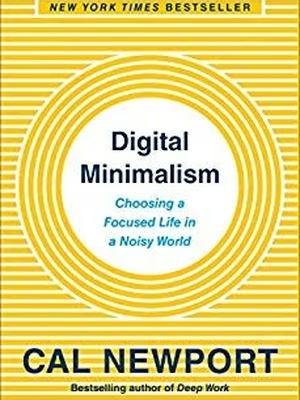
Most of us feel like we are losing control of our relationship with our phones. We check emails at dinner, scroll Instagram in bed, and feel phantom vibrations in our pockets. Cal Newport argues that this isn't an accident. We are fighting a losing battle against tech companies that spend billions of dollars to keep our eyes glued to the screen.
Digital Minimalism isn't about throwing your smartphone in the ocean and living in a cave. It is about being intentional. A digital minimalist creates a strict philosophy for which tools they use and why. If an app doesn't strongly support something they deeply value, they miss out on it, happily. This book provides the manual for taking your attention back.
My Take: The "Phone Foyer" Method
While the whole book is great, the part that stuck with me most wasn't just the "detox," but how to live afterwards. Newport suggests treating your smartphone like we used to treat landlines.
I created a simple rule based on this book called the Phone Foyer Method. When I get home, my phone goes on a small table in the entryway (the foyer). It stays there. If I need to look something up or call someone, I walk to the foyer, do the task, and walk away. It turns the phone back into a tool I go to visit, rather than a companion that follows me to the bathroom. This summary focuses on that shift: moving from "always on" to "intentional use."
Key Takeaways
The "Lopsided Arms Race"
We often blame ourselves for having no willpower, but Newport points out that this is unfair. We are fighting a lopsided war against tech giants who employ addiction specialists to hack our psychology. Realizing that the deck is stacked against you is the first step to stopping the shame and building a real defense strategy.
Optimization is Key
Digital minimalists don't ask, "Is there some benefit to this app?" (There is almost always *some* benefit). Instead, they ask, "Is this the best way to use my time to support my values?" Twitter might keep you informed, but if it makes you anxious and eats 2 hours a day, it is a bad trade even if it has "some" benefit.
Solitude Deprivation
For the first time in human history, it is possible to never be alone with our own thoughts. We can plug in headphones or look at a screen every single second we are awake. Newport argues that we are suffering from solitude deprivation, which leads to anxiety because we never give our brains time to process emotions or solve problems.
High-Quality Leisure
You can't just remove social media; you have to replace it with something better. If you create a void, you will slide back into scrolling. The most successful minimalists fill their time with demanding, physical, or social activities, like woodworking, board games, or fitness, that leave them too satisfied to care about what's happening on Facebook.
Chapter-by-Chapter Summary
Chapter 1: A Lopsided Arms Race
Newport starts by explaining why we are all so addicted. He dives into the history of the "like" button and infinite scroll. He explains that tech companies are in the business of harvesting attention to sell to advertisers. They use "intermittent reinforcement" (the same psychology as slot machines) to keep us checking for rewards.
Chapter 2: Digital Minimalism
This chapter defines the core philosophy. Minimalism isn't about being a Luddite (someone who hates tech). It's about focusing your online time on a small number of carefully selected activities that strongly support things you value, and happily missing out on everything else. It is a quality-over-quantity approach to apps.
Chapter 3: The Digital Declutter
This is the practical "how-to" chapter. Newport insists on a 30-day reset. You take a break from all optional technologies for a month. During this time, you rediscover what you actually enjoy doing. At the end of the month, you don't just turn everything back on. You only re-introduce apps that pass a strict test: "Does this serve a deep value?"
Chapter 4: Spend Time Alone
Newport explores the value of solitude (freedom from inputs from other minds). He looks at historical figures like Lincoln and Thoreau who used solitude to think clearly. The modern actionable advice here is simple: leave your phone at home when you go for a walk, or drive to the store without listening to a podcast.
Chapter 5: Don't Click "Like"
Social media tricks us into thinking that clicking a heart icon is "connection." Newport argues this is low-quality connection that drains us. He suggests a radical rule: Don't click like and don't comment. Instead, treat social media like a digital phonebook. Use it to find out what people are up to, then call them or meet them in person for real conversation.
Chapter 6: Reclaim Leisure
This chapter is about hobbies. Our leisure time used to be active (fixing cars, playing sports), but now it is passive (watching Netflix, scrolling TikTok). Newport argues that doing things in the physical world creates more energy than it uses. He encourages us to prioritize "strenuous leisure" that requires skill and effort.
Chapter 7: Join the Attention Resistance
The final chapter offers a grab-bag of tactics for sticking to your guns. Ideas include deleting social media apps from your phone (only using them on a desktop computer), dumbing down your smartphone, and turning your devices into "single-purpose" tools rather than swiss-army knives of distraction.
Main Concepts
The Bennet Principle
Newport references Arnold Bennett, who argued that energy comes from doing, not resting. We often think, "I'm tired from work, so I'll just sit and scroll." But that passive scrolling often leaves us feeling drained and groggy. Active leisure, like learning a guitar chord or cooking a complex meal, actually recharges our batteries better than staring at a screen.
The Maximalist
- Uses any app that has "some" benefit
- Fears missing out (FOMO)
- Allows notifications to interrupt focus
- Clicks "like" to maintain friendships
- Relaxes by consuming content
- Always accessible
The Minimalist
- Only uses apps that support deep values
- Happily misses out on the noise
- Batches tech use to specific times
- Calls friends for real conversation
- Relaxes by creating or doing
- Hard to reach, but fully present
Conversation-Centric Communication
Newport draws a hard line between "connection" (low-bandwidth text/likes) and "conversation" (high-bandwidth voice/face-to-face). He argues that text-based communication should only be used to handle logistics (setting up a meeting) or sharing simple info. It should never replace the nuance of hearing someone's voice.
How to Apply the Ideas This Week
You don't have to do the full 30-day detox to start seeing benefits. Here are four actions you can take this week to lower your digital anxiety immediately.
- Delete social apps from your phone. You don't have to delete your accounts. Just delete the apps from your smartphone. Force yourself to use Facebook or Twitter only on a desktop computer. This adds friction and stops the mindless "loop" of checking.
- Go for a walk without headphones. Leave the phone at home. No music, no podcasts, no calls. Just walk and let your brain think. It might feel boring at first, but that boredom is where your best ideas are hiding.
- Set "Office Hours" for texting. Instead of replying to every text instantly, tell close friends you are often away from your phone. Check and reply to messages in batches (e.g., once at lunch, once after dinner).
- Fix or make something with your hands. Spend one hour this weekend doing something physical. Repair a broken item, bake bread, or plant something. Notice how much better you feel compared to one hour of watching YouTube.
Memorable Quotes
“Humans are not wired to be constantly wired.”
“Digital minimalists see new technologies as tools to be used to support things they deeply value, not as sources of value themselves.”
“Simply put, humans are not wired to be constantly wired.”
“The urge to check Twitter or refresh Reddit becomes a nervous twitch that shatters uninterrupted time into shards too small to support the presence necessary for an intentional life.”
Who I Think Should Read This Book
- The "Burned Out" Worker: If you feel exhausted but can't stop checking email at 9 PM, this book gives you the permission and the logic to set boundaries.
- Anxious Students: If you feel like you are constantly performing for an audience online, Newport's advice on solitude can help lower your baseline anxiety.
- Creatives and Artists: Deep work requires focus. This book explains how to protect your brain so you can actually produce work that matters.
- Parents: If you want to model good behavior for your kids (or if you are worried about their screen time), the philosophy here is more effective than just shouting "get off the iPad."
What Other Readers Are Saying
Digital Minimalism is widely considered one of the most important books on modern technology habits. On Goodreads, it holds a strong rating of roughly 4.1 out of 5 stars with over 100,000 ratings. Readers love the "30-day declutter" concept because it provides a clear, actionable challenge rather than just vague advice.
On Amazon, the book averages around 4.5 out of 5 stars. Most positive reviews mention that the book helped them reclaim hours of their day. However, some critical readers feel the advice can be a bit elitist or difficult to follow if your job requires you to be on social media constantly. Despite that, even critics usually agree with the core premise: we are too distracted.
-
Read reviews on Amazon:
Digital Minimalism on Amazon
* Affiliate link. I earn from qualifying purchases.
- Read reviews on Goodreads: Digital Minimalism on Goodreads
Final Thoughts
Reading Digital Minimalism didn't make me hate technology; it made me respect it more. Before this book, I was a passive user, I let apps dictate my mood and my schedule. Now, using the "Phone Foyer Method" I mentioned earlier, I feel like I am back in the driver's seat.
The most liberating part is realizing that the world doesn't end if you aren't online for a few hours. In fact, the world gets brighter, quieter, and more interesting. If you feel like your brain has been hijacked, this book is the manual on how to steal it back.

Ready to Reclaim Your Focus?
This summary gives you the main ideas, but the full book goes deep into the history and philosophy of technology. If you are ready to try the full 30-day digital declutter, I highly recommend grabbing a copy.
Get Digital Minimalism on Amazon* Affiliate link. I earn from qualifying purchases.