Overview
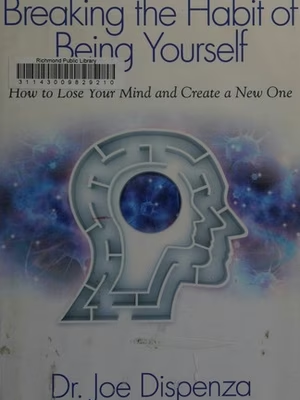
In Breaking the Habit of Being Yourself, Joe Dispenza blends neuroscience, quantum physics, and meditation to explain how we get stuck in repetitive thoughts and emotions. He argues that most of us live on autopilot, running the same mental programs every day, which keeps us trapped in the same version of ourselves. I like this book because it takes a scientific look at personal change and shows that transformation is not magic, it is biology.
Dispenza explains that every time we think a thought, our brain fires specific neural pathways, and the more we repeat those thoughts, the stronger those pathways become. Eventually, our personality becomes hardwired, and our body starts living in the past, addicted to familiar emotions like stress, anger, or anxiety. Throughout this page, I'll break down his ideas into practical steps so you can start interrupting old patterns and building new ones with intention.
My Take: A Three-Part Rewiring System
Most summaries treat this book like a dense science lecture and then move on. I wanted this page to feel more like a three-part rewiring system you can actually use to change your habits and thoughts. As you read, I'll keep pointing you back to these three steps: unlearn the old self, design the new self, and rehearse the new self until it becomes automatic.
I treat this book like an instruction manual for reprogramming my default settings. When I catch myself reacting the same way to the same triggers, I pause and ask, "What would the new version of me do here?" Then I use the meditation techniques Dispenza teaches to practice being that person in my mind before I try it in real life. You can use this same three-part loop, unlearn, design, rehearse, with any part of yourself you want to change.
Key Takeaways
Your Personality Creates Your Reality
For me, the core idea is that your personality is made up of how you think, act, and feel, and that combination creates your personal reality. If I keep thinking the same thoughts, doing the same things, and feeling the same emotions, I will keep getting the same results. To change my life, I have to change my personality, which means I have to change my habitual thoughts and emotional responses.
The Body Becomes Addicted to Emotions
Dispenza taught me that my body can become addicted to certain emotions, just like it can get addicted to caffeine or sugar. When I feel stress or anger repeatedly, my body learns to crave that chemical state, and it will actually seek out situations that let me feel that way again. Breaking free means recognizing when my body is asking for an emotional fix and choosing not to feed it.
Meditation Rewires the Brain
The book helped me see that meditation is not just relaxation, it is rehearsal for a new version of myself. When I sit down and mentally practice being calm, confident, or focused, my brain fires the same neural pathways it would use in real life. If I rehearse enough times in meditation, those new pathways become strong enough that I can access them when I need them most.
The Quantum Field Responds to Your State
Dispenza blends quantum physics with personal growth, suggesting that the field of infinite possibilities responds to our internal state, not just our wishes. When I shift my thoughts and emotions to match the person I want to become, I align myself with a new future instead of living in the past. It sounds abstract, but the practical part is simple: change your inner world first, then watch your outer world shift.
You Must Go Beyond Your Environment and Body
The hopeful part is that you are not stuck with who you have been. Dispenza shows that real change happens when you stop letting your environment and your body's emotional memory dictate your thoughts. By entering a meditative state where you go beyond your physical senses, you create the space to become someone entirely new.
Chapter-by-Chapter Summary (Short & Simple)
Introduction: The Greatest Habit You Can Ever Break
Dispenza opens by explaining that the greatest habit we need to break is the habit of being ourselves. He shares his personal story of healing from a serious spinal injury using only meditation and mental rehearsal. This introduction set the tone for me: if he could rebuild his spine with his mind, maybe I could rebuild my habits, emotions, and personality too.
Part I: The Science of You
In the first part of the book, Dispenza dives into the neuroscience of how we become who we are. He explains how our thoughts fire neural networks, how repetition hardens those networks into automatic programs, and how our body starts memorizing emotions as if they are part of our identity. These chapters helped me see that my personality is not fixed, it is just a set of patterns I have practiced over and over.
Chapter 1: The Quantum You
Here, Dispenza introduces quantum physics concepts in simple terms, explaining that at the subatomic level, matter is mostly energy and possibility. He argues that we are not just physical beings, we are also consciousness interacting with a field of potential. For me, the key takeaway is that I am not locked into one version of myself, there are infinite possibilities available if I change my thoughts and energy.
Chapter 2: Overcoming Your Environment
In this chapter, Dispenza explains how our external environment constantly triggers the same thoughts, which trigger the same choices, which create the same experiences. To change, I have to stop letting my surroundings control my internal state. He teaches that true change happens when I become greater than my environment, when I create a new reality in my mind before it shows up in my life.
Chapter 3: Overcoming Your Body
Here, Dispenza reveals how the body becomes addicted to emotions and starts running the show. When I feel stressed every day, my body learns to crave stress and will subconsciously create situations that let me feel it again. The solution is to recognize these emotional addictions and use meditation to break the body's control over my mind.
Chapter 4: Overcoming Time
In this chapter, Dispenza challenges the idea that we are stuck in linear time. He explains that when we live in stress, we are constantly pulling energy from the past and worrying about the future, which keeps us trapped. By entering a meditative state where I am present in the moment, I can step outside of time and access a state of pure creation.
Chapter 5: Survival vs. Creation
Dispenza contrasts the survival mode we live in most of the time with a higher state of creation. In survival mode, I am reactive, stressed, and focused on external threats. In creation mode, I am calm, focused inward, and able to design my future with intention. This chapter reminded me that I cannot create a new future while living in survival mode.
Part II: Your Brain and Meditation
The second part of the book shifts to practical application, teaching specific meditation techniques for rewiring the brain and body. Dispenza walks through how to prepare for meditation, how to enter the right mental state, and how to rehearse the new version of yourself until it becomes real. These chapters feel like a workshop where he hands you the tools to actually practice being someone new.
Chapter 6: Three Brains: Thinking to Doing to Being
Here, Dispenza explains the three parts of the brain and how they work together to turn thoughts into actions and then into automatic habits. The neocortex thinks, the limbic brain feels, and the cerebellum stores programs. For me, the big lesson is that I need to move an idea from my head to my heart to my body before it becomes who I am.
Chapter 7: The Gap
In this chapter, Dispenza explains the gap between who you are now and who you want to become. That gap is filled with uncertainty, discomfort, and the unknown, and most people avoid it because it feels scary. But crossing that gap is where transformation happens, and meditation is the bridge that lets me practice being in the unknown without fear.
Chapter 8: Meditation, Demystifying the Mystical, and Waves of Your Future
Here, Dispenza demystifies meditation by explaining the brain waves associated with different states of consciousness. He teaches that when I slow my brain waves down to alpha or theta, I enter a state where I can reprogram my subconscious mind. This chapter gave me a scientific reason to meditate instead of just hoping it would work.
Chapter 9: The Meditative Process: Introduction and Preparation
This chapter is a step-by-step guide to preparing for meditation. Dispenza covers everything from where to sit, how to breathe, and how to quiet the mind before you start the real work. I found this practical and reassuring, especially because he explains that meditation is a skill you get better at with practice, not something you are supposed to be perfect at right away.
Chapter 10: Open the Door to Your Creative State
In the final chapter, Dispenza walks through the core meditation technique: closing your eyes, moving your awareness to different parts of your body to release stored emotions, and then mentally rehearsing the new version of yourself. He teaches you to feel the emotions of your future as if they are happening now, which signals your brain and body to start living in that new reality. This is where all the science and theory turn into a daily practice.
Main Concepts
Neuroplasticity and Rewiring the Brain
One of the most hopeful ideas in the book is neuroplasticity, the brain's ability to form new neural connections throughout life. Dispenza explains that every time I think a thought, I strengthen certain pathways in my brain, and if I stop thinking old thoughts and start thinking new ones, the old pathways weaken and the new ones grow stronger. This means I am not stuck with the brain I have, I can rewire it through focused attention and repetition.
The Mind-Body Connection
Dispenza shows how the mind and body are in constant communication through hormones, neuropeptides, and other chemical signals. When I think a thought, my brain releases chemicals that make me feel a certain way, and then my body remembers that feeling and starts to crave it. Over time, my body becomes addicted to being me, and it resists change because change feels uncomfortable. The key is to understand this loop and use meditation to interrupt it.
Living in the Present Moment
A big theme in the book is the importance of getting out of the past and the future and into the present moment. Dispenza argues that when I am stuck in memories or worries, I am not available for creation. The present moment is the only place where I can access the quantum field and design a new future. Meditation helps me practice being present, which is the foundation for all other changes.
Mental Rehearsal
Dispenza is a big believer in mental rehearsal, the practice of imagining yourself doing something before you actually do it. He explains that the brain does not know the difference between a real experience and a vividly imagined one, so when I mentally rehearse being confident, calm, or successful, my brain fires the same neural pathways it would use in the real situation. By the time I face the real moment, my brain has already practiced, and the new behavior feels more natural.
How to Apply the Ideas This Week
I don't want this to just be an interesting summary you read and forget. Here are a few small, practical ways I use Dispenza's ideas in my own life. You can try them this week and see what shifts for you.
- Pick one habit or emotion to unlearn. Choose one pattern you want to break, like reacting defensively to criticism or feeling anxious before meetings. Write down what triggers it and how it makes you feel.
- Design your new self. Imagine the version of you that does not have that habit. How would that person think, act, and feel in the same situation? Write down a few specific traits or behaviors you want to practice.
- Rehearse the new self in meditation. Set aside 10 to 20 minutes each morning to sit quietly, slow your breathing, and mentally rehearse being the new version of yourself. Feel the emotions you would feel if you were already that person.
- Catch yourself in the old pattern. During the day, when you notice the old habit showing up, pause and remind yourself, "That is the old me, not the new me." Then consciously choose the new response, even if it feels awkward at first.
- Review your progress with curiosity. At the end of the week, ask, "Did I notice any changes in how I think, feel, or act?" The goal is not perfection, it is evidence that your brain is starting to rewire.
Memorable Quotes
"To change is to think greater than your environment."
"If you want a new outcome, you will have to break the habit of being yourself."
"Where you place your attention is where you place your energy."
"The moment you decide to make a different choice, get ready to be uncomfortable."
Who I Think Should Read This Book
- Anyone stuck in repetitive patterns: If you keep thinking the same thoughts, feeling the same emotions, and getting the same results, this book gives you a scientific roadmap for breaking the cycle.
- People curious about meditation: If you have heard about meditation but don't know how to start or why it works, Dispenza's detailed instructions and neuroscience explanations make it feel less mystical and more practical.
- Science-minded seekers: If you want personal growth ideas backed by research, brain scans, and quantum physics, this book blends spirituality with hard science in a way that feels grounded.
- People working on emotional healing: If you struggle with anxiety, stress, or old emotional wounds, the sections on emotional addiction and rewiring the body are especially helpful.
- Anyone ready to take full responsibility: If you are willing to accept that you create your own reality and that change starts with you, not with your circumstances, this book will give you the tools to do it.
What Other Readers Are Saying
I always like to see what other readers think before I commit to a book. On Goodreads, Breaking the Habit of Being Yourself sits around 4.1 out of 5 stars from over 37,000 ratings, which is solid for a book that blends science and spirituality. Many readers say the book is life-changing and that the meditation techniques are powerful, though some find the quantum physics sections a bit dense or repetitive.
On Amazon, the book holds ratings around 4.7 out of 5 stars, with readers praising the practical steps and the scientific explanations. Common themes in reviews include "this book changed how I see myself," "the meditations actually work," and "it is challenging but worth it." Some readers wish there were fewer repetitions of certain concepts, but most agree that the core message is profound and actionable.
-
Read reviews on Amazon:
Breaking the Habit of Being Yourself on Amazon
* Affiliate link. I earn from qualifying purchases.
- Read reviews on Goodreads: Breaking the Habit of Being Yourself on Goodreads
Final Thoughts
For me, the biggest gift of Breaking the Habit of Being Yourself is that it turns personal change into something concrete and doable. Instead of hoping I will feel different someday, I can use Dispenza's three-part system to unlearn old patterns, design new ones, and rehearse them until they become automatic. That shift from wishing to practicing makes transformation feel real and within reach.
If you use this summary as a starting point for your own rewiring work, you'll walk away with more than just notes about neuroscience and meditation. You'll have a clear process for becoming someone new, one meditation session at a time. That's the heart of Dispenza's message: you are not stuck with who you have been, and the power to change lives inside your own mind.
Ready to Rewire Your Brain?
If this summary helped you, the full book is worth reading slowly, with a notebook and a commitment to practice the meditations. You can use it as a daily guide to break old habits and build a completely new version of yourself.
Get Breaking the Habit of Being Yourself on Amazon* Affiliate link. I earn from qualifying purchases.